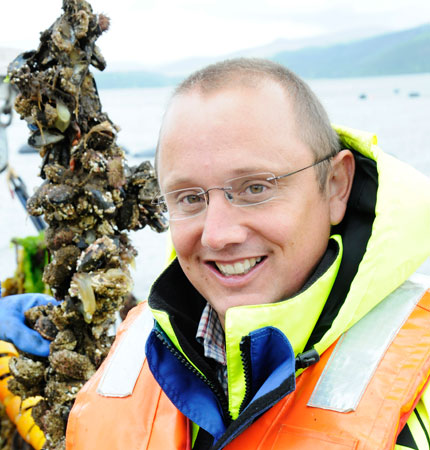
With global food security becoming more dependent on food farmed in the sea, producing that food sustainably is becoming increasingly important. I am a researcher and senior lecturer in sustainable aquaculture focusing on the development of economically and environmentally sustainable production systems for marine animals and plants.
I am a marine ecologist with over 20 years’ experience working in marine resource management and aquaculture. This has involved developing close links with small and large companies to diversify the industry and develop alternative high value products. I am also the co-ordinator of the €5.7M FP7 project IDREEM (Increasing Industrial Efficiency in European Mariculture) in which 15 partners across Europe collaborate to develop and to assess the social, economic and environmental performance of Integrated Multi-Trophic Aquaculture.
I am also involved in other national, European and international projects. I have previously sat on several ministerial working groups for the development of sustainable aquaculture; and on the Marine Alliance for Science and Technology Scotland (MASTS) steering committee for sustainable aquaculture. I am an editor for the journal Aquaculture Environment Interactions.
I have an extensive research interest in the development of the Blue Economy both in the context of Small Island Developing States (SIDS) and within Europe. I have worked with the Commonwealth Secretariat to provide guidelines for developing the Blue Economy in the Seychelles and other SIDS. I am an honorary Research Fellow with the Blue Economy Research Institute at the University of the Seychelles.
List of current research projects
SAICHATCH: Development of a blue mussel hatchery. Project coordinator and working on alternate larval diets. Funded by SAIC. June 2016-18 more...
Sustainable New Ingredients to Promote Health (SNIPH): This project aims to improve Omega-3 levels in farmed fish in Kenya, Tanzania and India using indigenous, non-conventional feed ingredients. Supported by BBSRC Newton Fund. May 2016-19
MacroFuels: Funded by EU H2020. Aug 2015-18.
SeaGas (Using seaweed for the generation of sustainable energy): The project has been awarded £2.78M over three years as part of the Industrial Biotechnology Catalyst. 2015-18
INNO-MPP: Identifying interactions between co-located marine renewable energy devices, aquaculture and the environment. Funded by EPSRC/NERC. 2017-20
INTEGRATE: Integrated Aquaculture - an eco-innovative solution to foster sustainability in the Atlantic Area. Funded by EU Interreg. 2017-20
List of selected past projects
Increasing Industrial Resource Efficiency in European Mariculture (IDREEM): Funded by EU. 2013-17
Advanced textiles for open sea biomass cultivation (AT~SEA). Funded by EU FP7. 2012-15
Selected journal articles (since 2012) - for a full list please visit my Google Scholar page
Laudicella VA, Carboni S, Whitfield PD, Doherty MK, Hughes AD (2023) Sexual dimorphism in the gonad lipidome of blue mussels (Mytilus sp.): New insights from a global lipidomics approach. Comparative Biochemistry and Physiology Part D: Genomics and Proteomics: 2023, 101150. https://doi.org/10.1016/j.cbd.2023.101150.
Hughes AD, Charalambides G, Franco SC, Robinson G, Tett P (2022) Blue Nitrogen: A Nature-Based Solution in the Blue Economy as a Tool to Manage Terrestrial Nutrient Neutrality. Sustainability 14(16): 10182 https://doi.org/10.3390/su141610182
Serpetti N., Benjamins S., Brain S., Collu M., Harvey B.J., Heymans J.J., Hughes A.D., Risch D., Rosinski S., Waggitt J.J. and Wilson B. (2021). Modeling Small Scale Impacts of Multi-Purpose Platforms: An Ecosystem Approach. Front. Mar. Sci. 8:694013. https://doi.org/10.3389/fmars.2021.694013
Callaway, R. et al. Review of climate change impacts on marine aquaculture in the UK and Ireland. Aquatic Conservation: Marine and Freshwater Ecosystems 22, 389-421 (2012).
Hughes, A. D., Brunner, L., Cook, E. J., Kelly, M. S. & Wilson, B. Echinoderms display morphological and behavioural phenotypic plasticity in response to their trophic environment. PloS one 7, e41243 (2012).
Hughes, A. D., Kelly, M. S., Black, K. D. & Stanley, M. S. Biogas from Macroalgae: is it time to revisit the idea? Biotechnology for biofuels 5, 1 (2012).
Carboni, S., Hughes, A. D., Atack, T., Tocher, D. R. & Migaud, H. Fatty acid profiles during gametogenesis in sea urchin (Paracentrotus lividus): Effects of dietary inputs on gonad, egg and embryo profiles. Comparative Biochemistry and Physiology Part A: Molecular & Integrative Physiology 164, 376-382 (2013).
Hughes, A. D. et al. Comments on ‘prospects for the use of macroalgae for fuel in Ireland and UK: an overview of marine management issues’. Marine Policy 38, 554-556 (2013).
Hughes, A. D. & Grottoli, A. G. Heterotrophic compensation: a possible mechanism for resilience of coral reefs to global warming or a sign of prolonged stress? PloS one 8, e81172 (2013).
Levas, S. J., Grottoli, A. G., Hughes, A., Osburn, C. L. & Matsui, Y. Physiological and biogeochemical traits of bleaching and recovery in the mounding species of coral Porites lobata: implications for resilience in mounding corals. PloS one 8, e63267 (2013).
Baumann, J., Grottoli, A. G., Hughes, A. D. & Matsui, Y. Photoautotrophic and heterotrophic carbon in bleached and non-bleached coral lipid acquisition and storage. Journal of Experimental Marine Biology and Ecology 461, 469-478 (2014).
Carboni, S. et al. Evaluation of flow through culture technique for commercial production of sea urchin (Paracentrotus lividus) larvae. Aquaculture Research 45, 768-772 (2014).
Panagos, C. G. et al. Fucosylated Chondroitin Sulfates from the Body Wall of the Sea Cucumber Holothuria forskali conformation, selectin binding, and biological activity. Journal of Biological Chemistry 289, 28284-28298 (2014).
Powell, C., Hughes, A., Kelly, M., Conner, S. & McDougall, G. Extraction and identification of antioxidant polyhydroxynaphthoquinone pigments from the sea urchin, Psammechinus miliaris. LWT-Food Science and Technology 59, 455-460 (2014).
Schoepf, V. et al. Kinetic and metabolic isotope effects in coral skeletal carbon isotopes: A re-evaluation using experimental coral bleaching as a case study. Geochimica et Cosmochimica Acta 146, 164-178 (2014).
Suckling, C. C. et al. Experimental influence of pH on the early life-stages of sea urchins II: increasing parental exposure times gives rise to different responses. Invertebrate Reproduction & Development 58, 161-175 (2014).
Carboni, S., Hughes, A. D., Atack, T., Tocher, D. R. & Migaud, H. Influence of broodstock diet on somatic growth, fecundity, gonad carotenoids and larval survival of sea urchin. Aquaculture Research 46, 969-976 (2015).
Kerrison, P. D., Stanley, M. S., Edwards, M. D., Black, K. D. & Hughes, A. D. The cultivation of European kelp for bioenergy: Site and species selection. Biomass and Bioenergy 80, 229-242 (2015).
Schiener, P., Atack, T., Wareing, R., Kelly, M. S. & Hughes, A. D. The by-products from marine biofuels as a feed source for the aquaculture industry: a novel example of the biorefinery approach. Biomass Conv. Bioref., 1-7 (2015).
Carboni, S., Clegg, S. H. & Hughes, A. D. The use of biorefinery by-products and natural detritus as feed sources for oysters (Crassostrea gigas) juveniles. Aquaculture 464, 392-398 (2016).
Hughes, A. D. & Black, K. D. Going beyond the search for solutions: understanding trade-offs in European integrated multi-trophic aquaculture development. Aquaculture Environment Interactions 8, 191-199 (2016).
Kerrison, P. D., Le, H. N. & Hughes, A. D. Hatchery decontamination of Sargassum muticum juveniles and adults using a combination of sodium hypochlorite and potassium iodide. J. Appl. Phycol. 28, 1169-1180 (2016).
Kerrison, P. D. et al. Decontamination treatments to eliminate problem biota from macroalgal tank cultures of Osmundea pinnatifida, Palmaria palmata and Ulva lactuca. J. Appl. Phycol., 1-12 (2016).
Kerrison, P. D. et al. Optimising the settlement and hatchery culture of Saccharina latissima (Phaeophyta) by manipulation of growth medium and substrate surface condition. J. Appl. Phycol. 28, 1181-1191 (2016).
KA Alexander, AD Hughes A problem shared: Technology transfer and development in European integrated multi-trophic aquaculture (IMTA) Aquaculture 473, 13-19 (2017)
Raphaëla Le Gouvello, Laure‐Elise Hochart, Dan Laffoley, François Simard, Carlos Andrade, Dror Angel, Myriam Callier, David De Monbrison, Davide Fezzardi, Ricardo Haroun, Alasdair Harris, Adam Hughes, Fabio Massa, Emmanuelle Roque, Doris Soto, Selina Stead, Giovanna Marino. Aquaculture and marine protected areas: Potential opportunities and synergies. Aquatic Conservation: Marine and Freshwater Ecosystems 27 (1): 138-150 (2017)
van der Molen, J., Ruardij, P., Mooney, K., Kerrison, P., O'Connor, N. E., Gorman, E., Timmermans, K., Wright, S., Kelly, M., Hughes, A. D., and Capuzzo, E. Modelling potential production of macroalgae farms in UK and Dutch coastal waters, Biogeosciences, 15, 1123-1147, https://doi.org/10.5194/bg-15-1123-2018 (2018)
Laudicella V, Whitfield PD, Carboni S, Doherty MK, Hughes AD (2019) Application of lipidomics in bivalve aquaculture, a review. Reviews in Aquaculture, 1-25. DOI: 10.111/raq.12346
Abhinav, K.A., Collu, M., Benjamins, S., Cai, H., Hughes, A., , Bod, J., Jude, S., Leithead, W., Lin, C., Liu, H., Recalde-Camacho, L., Serpetti, N., Sun, K., Wilson, B., Yue, H., Zhou, B.Z., 2020. Offshore multi-purpose platforms for a Blue Growth: a technological, socio-economic, and environmental review. Science of the Total Environment, 734: 138256. https://doi.org/10.1016/j.scitotenv.2020.138256
Penhaul Smith, J.K., Hughes, A.D., McEvoy, L., Thornton, B., Day, J.G. (2021) The carbon partitioning of glucose and DIC in mixotrophic, heterotrophic and photoautotrophic cultures of Tetraselmis suecica. Biotechnol Lett https://doi.org/10.1007/s10529-020-03073-y
Commissioned Reports
Tett P, Benjamins S, Black KD, Coulson M, Davidson K, Fernandes T, Fox C, Hart M, Hicks N, Hughes A, Hunter D-C, Nickell T, Risch D, Tocher D, Vare L, Vespoor E, Wilding T, Wilson B, Wittich A (2018) Review of the environmental impacts of salmon farming in Scotland. Report for the Environment, Climate Change and Land Reform (ECCLR) Committee. The Scottish Parliament, 196 pp.
Hughes, A, JG Day, L Greenhill and MS Stanley (2016), Aquaculture, Commonwealth Blue Economy Series, No. 2. Commonwealth Secretariat, London.
Greenhill, L, JG Day, A Hughes and MS Stanley (2016), Marine Renewable Energy. Commonwealth Blue Economy Series, No. 4. Commonwealth Secretariat, London.
Day, J, A Hughes, L Greenhill and MS Stanley (2016), Blue Biotechnology. Commonwealth Blue Economy Report Series, No. 5. Commonwealth Secretariat: London.
Aquaculture, Environment and Society MSc: Module leader for 'Innovation, Technology and Systems'
Current research students
Alessandro Laudicella: PhD student. University of the Highlands and Islands
Joe Penhaul-Smith: Utilising microalgal mixotrophy to maximise larval nutrition. PhD student. University of the Highlands and Islands
Francesco Boatta: MSc student. University of the Highlands and Islands
Employment history
2014-present: Senior Lecturer in Sustainable Aquaculture. SAMS
2010-14: MASTS Lecturer in Sustainable Mariculture. SAMS
2009-10: Research Associate in Invertebrate Ecology. SAMS
2006-08: Research Scholar in Coral Bleaching Biochemistry. Ohio State University and University of Texas. USA
Education
2006: PhD 'The Role of Sea Urchin Grazing in Structuring Benthic Communities in Scotland.' SAMS/UHI/Open University